Blog

Only a “secrete recipe” can defend you from competitors

“Secret recipe” of your business

I have good news for those who complain “If the market wants
something that I can’t or don’t want to provide?” This exercise
will be for you to make your business special.

We already know how much it’s important to meet the needs of
your customers
, and even more critical to satisfying the priority
need
of your Persona. But we know examples such as Steve
Jobs who felt confident to tell customers what they need. It
excites when a businessman foresees the potential needs of
the market, creates a totally new need, or beats all competitors
with an innovative product.

It’s not a secret that people sometimes want to eat out fast
and at a decent price, that is why there are multiple fast foods
cafes scattered everywhere – they all satisfy the specific need of
the market. And, my question here is why do you know
nothing about them
, but do know about McDonalds?

Is it tastier? Better operational efficiency? Prices? Menu?
Wait a second, what is at the core of Mcdonald’s business?
Let me assume that the company you can find in every corner
of the world manages to satisfy your expectations at the same
level no matter if you buy your De Lux burger in Paris or in
Spain. The burger, the service, and the environment will be at the
same level.

So, we can say that at the core of this business is “a
customers get what they expect to get”.

The good thing about this “secret recipe” exercise is that you
don’t need to ask people, experts, or the market. All you need is just
to take a cup of coffee, embrace all you insights you got from
research before, and deeply think about what one specific you would
put at the core of your business
that resonates with you and
the market?

Something that will make customers leave competitors and
be obsessed with your product?

It could be anything: low price, unforgettable service, excellent
quality. But don’t mix it up with market entry strategy. You can
choose to enter the market with a low price, selling lemonades
and when the market gets addicted to your beverage, sell
an upgraded version at a higher price. The price is just a strategy,
the “secret recipe” is an addictive taste that captures the market.

It also can happen that you defined the core of your business
but later changed it, getting more market insights.

Finally, we can for sure call it a “secret recipe” because this
is something that must defend your business from
competitors, the “secret recipe” can’t and shouldn’t be replicated easily!
Can you sell to your first customer?

Product idea proof via first sales

#startup_notes

When you enter a new market, trying to sell your innovative, life-changing product, there is always a step when you must prove your business idea. At this point, you find 10 customers and sell your product or service to them. Yes, like this.


Because, when does your business exist? When do you have a business model or a sample of your product? No!


Your business exists only when you have PAYING customers


That is why what you need to do is to list potential customers who are very, very similar to your Persona. Why do we need to do it?


1) Because it’s a test drive for our product
2) Business is built on the need for Persona


Some entrepreneurs, skipping this step make a huge mistake, especially if they build a product first, investing money and time in it. But then nobody buys the product, it’s so painful. I had such an experience, when we created a new service (thank God it was a service not even a product) for our tutoring platform but wasted money on advertising not even reaching 1% of conversion into sales! I still remember how hard it was to stop ad campaigns because of already happened sunk costs, despite all irrationality.


The good thing is you can use this trick to assure yourself and investors that your business model is sustainable and will not fail, as you have no potential but already paying customers.


The list of actions to be taken:
1) List more than 10 potential customers (better if twice or 3 times more)
2) Contact each of them to validate your hypothesis about Persona’s priority need and other assumptions, specifically:
a) show the product and its features
b) explain when it will be used (Life Cycle Use)
c) Share Value Proposition
3) Ask for feedback, especially pay attention to a negative one
4) Ask if he or she will be interested in purchasing and notified when the product is ready? (Don’t push)
5) Make a list of contacts who are interested
6) Analyse all received information and how to deal with it
7) When the product is ready, try to sell


It doesn’t mean you must sell your product by all means, the idea of this step is to get enough proof that your product meets the needs of the market, so if nobody wants to buy your product or the selling process is too complicated, it might be a sign that you shouldn’t bet on it, or something needs to be fixed.


Also, when I say 10 customers, this number will be different for different businesses, if you sell highly marginal products, you can sell to fewer people.

Value Proposition

Value proposition, or what really makes people buy

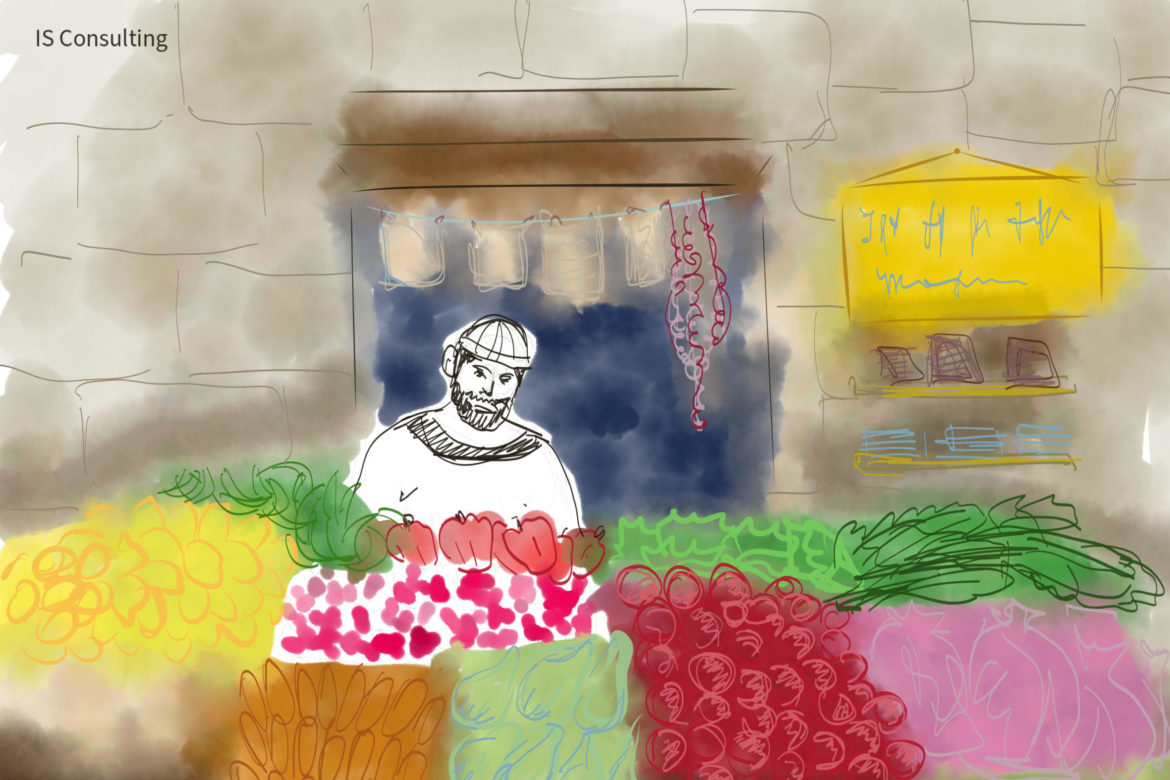
Imagine that you are walking through the local market, everywhere you look there are the same veggies and fruits. What are you looking for? Value for money? Yes, usually it is true for most of us. We don’t want to buy rotten apples or overpriced apples. But we all have our high priority, it might be “cheaper”, “better” or “faster”. Let’s say we are wealthy enough not to worry about the price, but our reason for coming to the market is to find truly juicy fresh delicious fruits, then all the callings from the sellers about “good price” will pass by our ears.

However, seeing a stall where there are many sellers working fast, shouting “the best freshest fruits delivered from Morocco 2 hours ago” may hit our customer’s “pain” or “need”: to get fresh and delicious fruits. If my assumption about Moroccan fruits lined up with my need, I will get interested. This is the Value Proposition that makes me interested.
In other words, VP (Value Proposition) is the benefits your customer gets from your product or service. If a customer is not interested in your product, it may mean that your VP is irrelevant or not clear for a customer.
Example: We sell stroller fan for kids, so our competitors propose the same features of the product, meeting customer needs (a calm baby), but we also design the look of the fan entertaining, with long-lasting battery and safe plastic.
Now we can enlist the benefits of such a fan:
BENEFITS:Bright design

Soft fan blades

Long-lasting battery

Blows intensively

And now it’s time not to forget about 2 things.
1) Translate VP to Customer’s language
2) Summarise all the benefits in one sentence, hitting high-priority need
3) Quantify VP
Doing the first, it might sound like these:
BENEFITS:
Bright design -> You kid get entertained
Soft fan blades -> Safe for your kid
Long-lasting battery-> 96 hours of work
Blows intensively -> Your kid is no more irritated with hot weather-> no cries from your kid
Then you can ask how can you put all in one sentence?
Unfortunately, we can’t stress on all benefits simultaneously, as the message should be very clear, catch eyeballs, of course improving high-priority need. So, I would dare to suggest something like “peaceful stroller walks with our toy-fan”. I don’t mention about safety as it is easily seen that blades are soft, I don’t say a word about cooling effect as everybody understands the main function of the fan, but I pay attention to what my customer will get “peaceful stroller walks” because “toy-fan” will make a kid entertained not just fresh up as a usual portable fan.
You can think up better versions of VP in one sentence if you have.
The other way to be clear about the benefits is to use “as is” and “to be” approach.
For instance, a typical blood tests for diabetes require up to 6 punctures with a needle daily. This is crazy, my mum was diabetic and she had to carry her test kit everywhere, taking blood multiple times a day and to the end of her life. But today there a new product called Freestyle Libre that solves the “pain” of such people like my mum. This is a sensor that can be applied once in 14 days, water resistant, doesn’t require any punctures.
On the official website we find this “With the FreeStyle Libre 2 system, you can check your glucose with a painless scan instead of fingersticks” . In my opinion it sounds good enough, as the product is supposed for diabetics, they are aware of “fingersticks” (what it means) and the word “painless scan” explains that it’s not a needle, no puncture, no pain respectively.
Finally, sometimes VP is better to quantify, especially when it’s not obvious for a customer how beneficial it is.
The simplest way to understand it is this: once I was at the gym and the manager was trying to quantify for me how beneficial it will be (in terms of money) if I pay for an annual membership instead of monthly payments.
It’s about quantification, but what about quantified VP?
Don’t forget that VP is about VALUE, something that you propose to your customer, that solves his or her major problem. Then you just need to show up tangible metrics in saved hours, money, and nerves))
Give me your examples of the following Quantified VP, please!  “We deliver groceries fast and cheap”START-UP